Rock Paper Kingdoms
- 4.7
- Rating
- 10.00K
- Installs
- Free
- Price
 Analysis by App-foxy
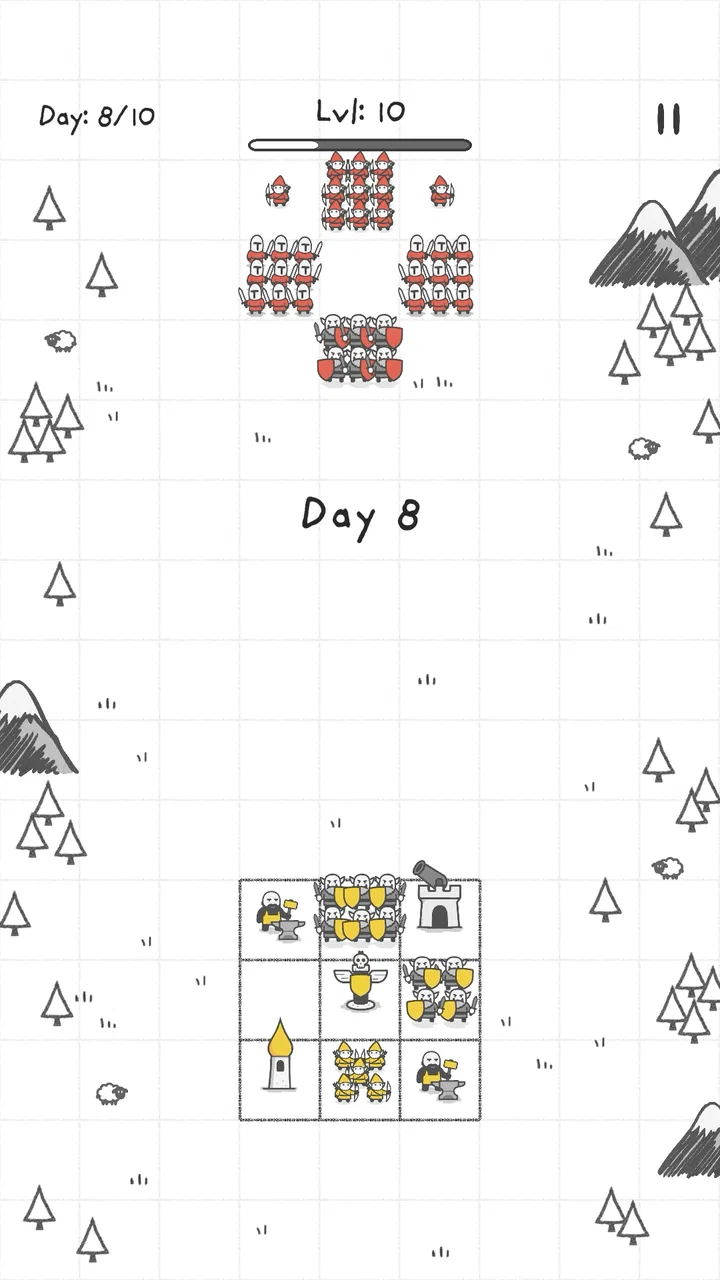
I spent time with Rock Paper Kingdoms, a free strategy game from TapHub Games that turns the familiar rock-paper-scissors idea into a small kingdom-defense challenge. Its basic promise is easy to understand: summon units, improve your army, and hold back repeated enemy sieges. What makes that premise interesting is the decision-making behind each summon. You are not simply tapping through an attack button; you are trying to build a lineup that can survive what is coming next.
This is the kind of game I can imagine opening during a short break, playing a few rounds, and then returning to later because one failed defense leaves me thinking about a better formation. It is approachable enough for someone who normally avoids complicated strategy games, but it still asks you to pay attention to counters, upgrades, and timing. My overall impression is positive, although its appeal depends heavily on whether you enjoy repeating defensive encounters and gradually refining a small army.
How the free model affects the experience
The game is available at no upfront cost, which makes trying it straightforward. You can install it without committing money first, see whether the rock-paper-kingdom formula suits you, and decide from actual play rather than screenshots or a short description. That free entry matters here because strategy games can feel very different once their pacing and upgrade loops become clear.
You May Also Like

 Pandora - Music & Podcasts
Pandora’s Music Is Easy to Start, but Harder to Recover
Pandora’s strength is its low-effort path from a seed to a station. Its weak spot is how much confidence it asks you to place in connection, setup, and quiet recovery.

 AccuWeather: Weather Radar
AccuWeather Review: A Quick, Clear Forecast for Everyday Decisions
For everyday plans, the best forecast is the one you can understand quickly. AccuWeather makes rain timing, radar, and local conditions easy to act on, with a few trade-offs.

 Hill Climb Racing
Why Hill Climb Racing Still Turns Crashes Into One More Run
A tiny car, a bumpy hill and one more upgrade: Hill Climb Racing keeps resurfacing because its simple chaos makes every near-miss feel personal.

 AliExpress - Shopping App
AliExpress Makes Global Shopping Feel Personal, but Shoppers Bear the Risk
AliExpress turns a global marketplace into a pocket-sized discovery engine. Its reach is useful, its shopping loop compelling, and its trade-offs easy to miss.

 Lords Mobile: Kingdom Wars
Lords Mobile Is a Kingdom-Building Routine, Not a Quick Match
A case-by-case verdict on the building, battles, device demands, and social commitments that make Lords Mobile rewarding for some players and exhausting for others.

 PDF Scanner app - TapScanner
TapScanner Makes Paperwork Easier to Capture, Check, and Share
TapScanner makes scanning with a phone feel less like a rescue operation and more like a dependable step in getting work done. Its capture tools are useful, though not flawless.
More From Our News Desk
View All News


There are in-app purchases priced from $0.99 to $49.99 per item. I would treat that range as a reason to play patiently before spending anything. The free access gives you a chance to judge whether progress feels satisfying on its own, while the purchase options are best considered optional rather than part of the basic admission price. I would not recommend buying immediately just to solve an early difficulty spike. First learn which unit combinations and upgrade choices consistently help your defense.
That distinction is important: the game is free to access, but it is not accurate to describe every possible progression shortcut as free. If you are comfortable experimenting and repeating a battle after a mistake, the no-cost starting point should be enough to evaluate the core loop. If you dislike games that include optional spending, even a well-balanced free entry may not feel comfortable.
The age rating is Everyone, so the presentation is positioned for a broad audience. That makes the game easier to recommend for casual family play or for someone looking for strategy without a mature theme. I still think the best audience is defined more by patience than age. The central challenge is not reflex speed; it is noticing patterns and accepting that a failed siege may be useful information.
The first battles are easy to understand
My first useful habit was to stop treating every summon as an urgent answer. The rock-paper-scissors foundation encourages quick countering, but a defense can become weaker if you spend everything reacting to the immediate threat. I found it more helpful to think one step ahead: which unit is handling the current enemy, what might be vulnerable afterward, and whether an upgrade would be more valuable than another summon.
That creates a pleasant tension between short-term survival and long-term army strength. A unit that solves the present wave may not be the best investment for the next one. When I played carelessly, I could still make progress for a while, but the weaknesses of my lineup became obvious once the pressure increased. The game rewards a calmer approach than its simple premise initially suggests.
The most useful practical tip is to remember why you lost, rather than immediately repeating the same setup. If one type of enemy repeatedly breaks through, changing only the final unit may not be enough. Look at the whole sequence of decisions: when you summoned, what you upgraded, and whether you committed too much to one counter. That small review turns a retry into a strategy exercise instead of a mindless reset.
Upgrades are decisions, not just rewards
Upgrading an army feels most valuable when it supports a clear plan. I prefer strengthening the units that fit the way I am already defending instead of spreading improvements randomly across everything. A broad collection can look impressive, but a focused group is easier to understand and easier to deploy under pressure.
There is also a trade-off between flexibility and efficiency. A narrow strategy may perform very well against familiar patterns, but it can become uncomfortable when the siege asks for a different response. A more varied army may take longer to develop, yet it gives you more ways to recover from a bad matchup. I would advise new players to begin with a dependable core and add variety once they understand what each counter is doing for them.
This is one of the places where the game feels more thoughtful than its short description suggests. Summoning and upgrading are connected choices. If you only chase the strongest-looking improvement, you may end up with an army that is powerful in theory but awkward to use when the enemy sequence changes. I got better results by asking, “What problem will this upgrade solve?” rather than simply choosing the biggest visible increase.
What value the game delivers
The strongest value comes from its low barrier to entry and compact strategic loop. I do not need to learn a large rulebook before making meaningful decisions. The familiar counter relationship gives every battle an immediate language, while the kingdom-defense setting adds enough structure to make those choices feel connected to a larger goal.
For a short-session player, that combination is useful. I can approach a battle with a simple plan, notice where it fails, and return with one adjustment. The experience does not require me to remember a complicated story or manage a huge collection of unrelated systems. Its value is concentrated in the repeated question of whether my army is prepared for the next siege.
It is also a reasonable introduction to strategy for someone who finds traditional tactics games intimidating. Compared with a large turn-based game, this is easier to pick up. Compared with a purely idle defense game, it gives me more ownership over the outcome because counters and upgrades matter. That middle ground is probably its clearest identity.
At the same time, players seeking a deep campaign, extensive world-building, or highly elaborate tactical maps may find the scope modest. I would not choose it as a replacement for a full-scale strategy title. Its value is in focused decisions and repeatable defense, not in offering the breadth of a long-form kingdom simulator.
Where the trade-offs become noticeable
The same simplicity that makes the game welcoming can eventually limit its appeal. Once I understood the basic counter logic, the question became whether later encounters continued to introduce enough meaningful variation. Players who enjoy mastering a compact system may be happy to keep refining their approach. Players who need constant novelty may feel the loop becoming familiar sooner.
Repeated sieges can also create a particular kind of friction. Losing is useful when it teaches me something, but less satisfying when a defeat feels like a check on progression rather than a mistake I can correct. That is why I would pay close attention to how much I am learning from each retry. If I am changing decisions and seeing better results, the repetition works. If I am only waiting for stronger upgrades, the strategy layer feels thinner.
The purchase range adds another consideration. Because individual items can cost from $0.99 to $49.99, I would set a personal spending limit before exploring optional purchases. The free version is the right way to test the game, and spending should follow a clear judgment that the extra value is worth it to you. I would especially avoid treating a purchase as a substitute for understanding counters. Better planning is usually the first solution to try.
Another trade-off is that the game’s approachable rules may not satisfy players who want many simultaneous variables. If you prefer detailed resource economies, large maps, diplomacy, or long-term political planning, this is not the right kind of strategy. Its decisions are closer to building and adjusting a fighting roster for defensive pressure than running an entire kingdom.
A realistic everyday use case
Imagine having ten minutes before leaving for work or while waiting for an appointment. I would open the game, attempt one siege, and use the result to identify a single weakness in my lineup. If the battle ends quickly, I can make one upgrade or change the order of my summons before trying again. That gives the session a clear purpose without requiring a long uninterrupted commitment.
For a longer evening session, I would recommend keeping a simple mental note of which counter choices worked. The game becomes more enjoyable when I treat each attempt as a small experiment. For example, instead of changing three things after a loss, change one part of the army and see whether the result improves. That approach makes progress easier to understand and prevents the upgrade system from feeling random.
I would not recommend using it as background entertainment while doing something else. The decisions are simple enough to learn, but they still need attention. If I stop watching the enemy sequence or tap through summons without thinking, I lose the part of the game that makes it worthwhile.
Who will get the most from it
This is a good fit for players who like accessible strategy games with a clear counter system. It should appeal to someone who enjoys improving a lineup, testing small changes, and defending against escalating pressure without learning a sprawling ruleset. It is also suitable for people who want a free game they can evaluate gradually rather than paying before knowing whether the central loop works for them.
I would particularly suggest it to a friend who likes the satisfaction of finding the right answer to a tactical problem but does not want a complex interface. The summon-and-upgrade structure is easy to explain, yet it leaves room for useful choices about concentration, flexibility, and timing.
On the other hand, I would tell competitive multiplayer fans to look elsewhere if their main goal is direct human opposition. The appeal here is the personal challenge of preparing for and surviving sieges, not the social tension of outsmarting another player in real time. Likewise, fans of narrative-heavy kingdom games may find the defensive focus too narrow.
The current version is 0.2.1, which also makes me approach it as a developing experience rather than a finished, all-encompassing strategy package. That does not make it a poor choice, but it does reinforce my advice to judge it by the loop that is available now. If you want a compact game to try and revisit, that is reasonable. If you expect a huge amount of content immediately, keep your expectations measured.
How it compares with familiar alternatives
Against traditional rock-paper-scissors games, this adds persistence and planning. The choice is no longer just about selecting the winning symbol in one isolated exchange; it is about building an army that can handle a sequence of threats. That gives the familiar rule a stronger reason to keep playing.
Against idle defense games, it feels more involved because I need to think about counters and upgrades rather than simply watching numbers rise. However, someone who wants a mostly hands-off experience may prefer an idle alternative. The more attention I give to the battle, the more value I get from this game’s design.
Against large strategy games, it is much easier to start and much less demanding to manage. The cost of that accessibility is depth in other areas. There is no reason to choose it over a grand strategy title if your enjoyment comes from diplomacy, territory control, or complex economies. Choose this instead when you want a focused army-building puzzle with defensive pressure.
That comparison helped clarify my recommendation. The game is not trying to replace every strategy format. It works best as a lightweight, focused option between a simple casual title and a demanding tactical campaign.
My final recommendation
After playing it, I see Rock Paper Kingdoms as a worthwhile free download for anyone curious about a simple counter-based defense game. Its strongest qualities are the clear premise, the approachable army-building decisions, and the way a failed siege can encourage a smarter retry. The 4.7 average from around 460 ratings and over 10K installs suggest that the early audience has responded well, although I would still rely on your own first sessions to decide whether the repetition suits you.
I would start without spending, experiment with a focused core army, and make changes based on specific failures. If you enjoy that process, optional purchases can be considered as a personal convenience, but they are not a reason to skip learning the system. If you dislike repeated defensive encounters, want a deep kingdom simulator, or prefer direct multiplayer competition, another strategy game will probably serve you better.
For me, the verdict is a cautious recommendation: try it because the entry cost is free, stay if the counter-and-upgrade loop keeps giving you problems worth solving, and skip purchases until the game has earned your confidence. It is small in scope, but within that scope it offers a friendly way to practice planning, adaptation, and restraint.
FAQs for Rock Paper Kingdoms
01What is Rock Paper Kingdoms, and how does the gameplay work?
Rock Paper Kingdoms is a strategy game built around the familiar rock-paper-scissors concept, expanded into kingdom management and battles. You typically develop your territory, collect or improve units, and choose counters carefully during combat. The simple core mechanic is easy to understand, but successful progress depends on planning, upgrading the right forces, and adapting your strategy to different opponents.
02Is Rock Paper Kingdoms free to download and play?
The game can generally be downloaded and played without an initial purchase, although availability and pricing may vary between Android and iOS. As with many mobile strategy titles, it may include optional in-app purchases for resources, upgrades, cosmetic items, or faster progression. You should review the store listing and purchase settings before playing, particularly if children use the device.
03Does Rock Paper Kingdoms require an internet connection?
An internet connection may be needed for features such as account synchronization, advertisements, events, online competitions, updates, or other server-based content. Some basic activities may work offline, but the exact experience can depend on the current version and device. If you plan to play while traveling, it is best to test the game beforehand rather than assume every mode will remain available without connectivity.
04Is Rock Paper Kingdoms suitable for children and casual players?
Rock Paper Kingdoms is approachable for casual players because its central combat idea is immediately recognizable and does not require complicated controls. However, kingdom-building systems, timers, competitive elements, and optional purchases may require supervision for younger users. Parents should check the age rating, privacy information, advertising content, and in-app purchase settings before allowing a child to download and play.
05What should I know about progression and in-app purchases before downloading?
Progression usually involves completing battles or objectives, earning resources, unlocking content, and upgrading your kingdom or units. The early stages are often straightforward, but later progress may take more time or encourage the use of premium resources. Purchases are normally optional, yet they can affect convenience or competitive progress. Check whether your preferred play style supports patient, free progression before spending money.
Pros
- Quick matches make it easy to play during short breaks.
- Simple rock-paper-scissors rules are accessible to new players.
- Kingdom progression gives each session a clear sense of purpose.
- Strategic choices add more depth than a basic luck-based match.
- Colorful visuals make the game pleasant to browse and play.
Cons
- Match outcomes can sometimes feel overly dependent on luck.
- Progress may become repetitive after extended play sessions.
- Some upgrades or content may require considerable time to unlock.
- The interface can feel busy when several kingdom elements appear together.
- Players seeking deep strategy may find the core mechanics limited.

Rock Paper Kingdoms
Gallery